
Genome Editing Research and Development Unit
Research Topics
Programming Genomic Time
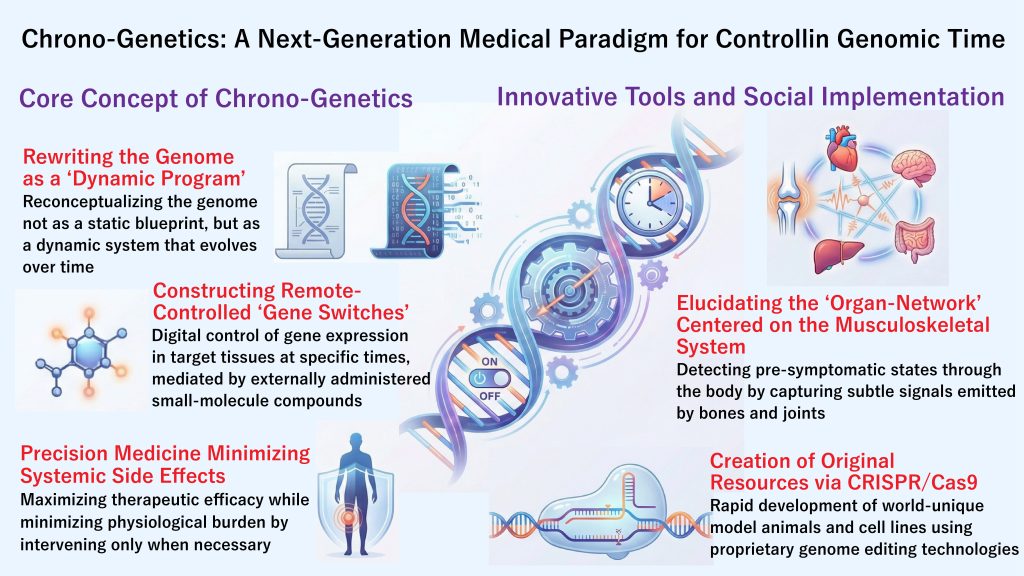
Our unit focuses on an innovative technology that enables the flexible integration of externally accessible temporal switches into specific genomic regions. Through this core technology, we are advancing Chrono-Genetics to achieve fundamental solutions for a wide range of diseases.
Chrono-Genetics reconceptualizes the genome: it is no longer viewed as a static blueprint but as a dynamic program that evolves continuously over time. This represents a new paradigm in life manipulation, utilizing genome editing to externally control exactly when and at what timing specific gene expression is toggled on or off.
1. Precision Medicine via Remote-Controlled Gene Switches
We are pursuing the ultimate form of precision medicine by controlling gene expression through small-molecule compounds that specifically respond to unique sequences integrated via genome editing.
Strategic Intervention: We aim to construct an innovative gene switch operation system that digitally controls target transcription factors and signals (e.g., NF-κB) in specific tissues at specific times. This approach enables next-generation therapeutic strategies that dramatically improve pathological conditions while minimizing systemic side effects.
2. Musculoskeletal Pathophysiology and Chronotherapy via Circadian Rhythms
Maintaining the functions of the musculoskeletal system, including joints and bones, is a paramount challenge for extending healthy life expectancy. We utilize unique molecular biology techniques to clarify the roles of the circadian clock in musculoskeletal homeostasis.
Creation of Time Mosaic Mice: Our newly discovered compound, Mic-628, is a revolutionary tool that advances specific clock genes in a time-independent manner (Takahata et al., PNAS, 2026). By applying this tool, we aim to establish chronotherapy—intervening at the optimal timing aligned with biological rhythms—for intractable conditions such as osteoarthritis (OA) and rheumatoid arthritis.
3. Organ-Network: Musculoskeletal Biomarkers and Systemic Intercommunication
The musculoskeletal system acts as one of the command centers governing systemic health. We capture subtle signals emitted by joints and bones to reveal the mechanisms controlling systemic aging and disease.
Systems Biology Perspective: We analyze the impact of synchronization or desynchronization between musculoskeletal phases and systemic organs on overall health. By identifying new biomarkers to detect pre-symptomatic states, we construct personalized health maintenance strategies at the individual level.
4. Creation of “Unique Research Resources” through Advanced Genome Editing
Fighting with weapons only you possess in the world—this is the core philosophy of our unit.
Proprietary Development: Rather than relying on existing mouse lines, we independently develop technologies for rapid individual generation using CRISPR/Cas9 and epigenetic control using dCas9. By utilizing these self-created mice and cell lines as a starting point, we embody highly original science that remains peerless.
Staff
| FACULTY Member | E-Mail(add ”@osaka-u.ac.jp”) | |
| Associate Professor | Yoshifumi TAKAHATA | takahata.yoshifumi.dent |
| Assistant Professor | Emi ONO | ono.emi.dent |
| Technical Staff | Miho KAKIUCHI | kakiuchi-mi@office. |
Unit Leader, Genome Editing Technology Development Unit Researchmap
Information on Research Support
Rewriting the ”Blueprint (Genome)” to Unveil the Truth of Life
Genome editing technologies, spearheaded by CRISPR/Cas9, are fundamentally redefining the landscapes of life sciences, medicine, and drug discovery. At the Genome Editing Technology Development Unit, our mission transcends mere mouse production: “Transforming researcher inspiration into high-precision individual models via the shortest possible path.”
1. End-to-End Strategic Consulting: From Concept to Analysis
We bring “bespoke design” to life—whether it is a specific disease model, precise mutation, or the integration of sophisticated genetic switches.
Comprehensive Support: We provide integrated assistance, from the optimal design of target gRNAs and selection of the latest editing methodologies to the fine-tuning of efficient genotyping protocols.
Proven Global Excellence: Our proprietary techniques have yielded research outcomes featured in top-tier journals, including a recent publication achieving an Altmetric score of 218 (placing it within the top 0.1% of all research globally), a testament to our world-class technical expertise.
2. Safeguarding and Restoring Research Resources via Reproductive Engineering
Promoting open science and preparing for unforeseen contingencies are essential strategic imperatives for modern laboratory management.
Backup Solutions: We protect your invaluable research resources through the cryopreservation and stable storage of sperm and embryos.
Individual Revitalization: Leveraging advanced reproductive technologies—including in vitro fertilization (IVF) and embryo transfer—we provide high-level support to rapidly restore cryopreserved resources back into live individual models when needed.
Our goal is to evolve genome editing from a niche expertise into a universal weapon for every researcher.
3. Democratizing Technology and Cultivating the Next Generation
Practical Seminars: We host regular sessions ranging from insights into the latest trends to hands-on workshops designed for immediate application in the field.
Creative Research Consultations: We welcome early-stage ideas, such as ”Is it possible to create this specific mouse model?” Please feel free to contact us for a consultation.
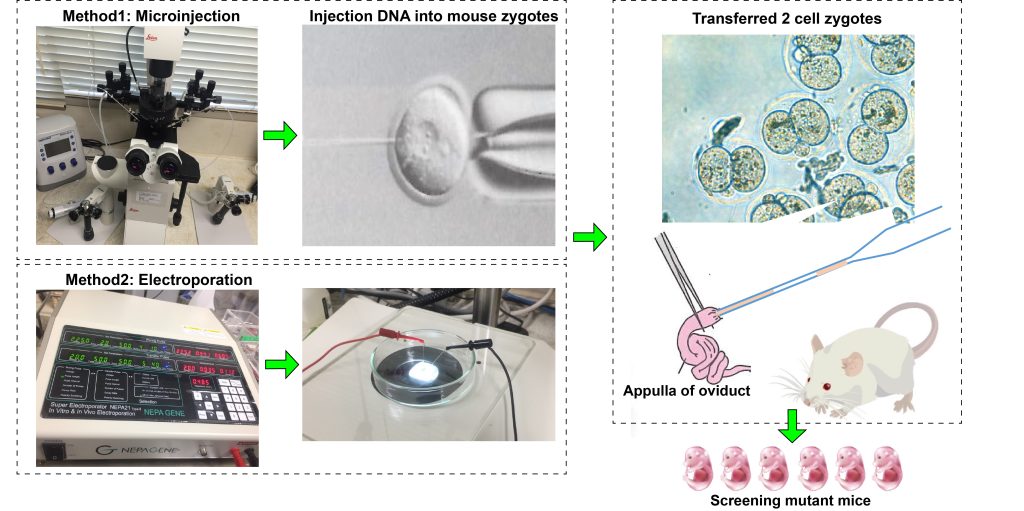
Figure: Generation of genetically engineered mice.
News
May 1, 2026
New Member Joins the Unit
Emi Ohno (Assistant Professor) has joined our unit.
January 23, 2026
Publication in PNAS: Identification of Mic-628 for Time-Independent Circadian Clock Advancement
We have successfully identified Mic-628, a novel compound that specifically induces the Period1 gene. Through a multidisciplinary approach integrating biochemical validation, physiological behavioral analysis, and mathematical modeling, we demonstrated that this compound stably and powerfully advances the circadian clock independently of the time of administration. These results propose a new paradigm for temporal manipulation that overcomes the traditional constraints of the Phase Response Curve (PRC), representing a breakthrough toward addressing health disorders associated with jet lag and shift work. This research was published in the Proceedings of the National Academy of Sciences of the United States of America (PNAS).
Article URL: https://www.pnas.org/doi/10.1073/pnas.2509943123
Full Press Release:AlphaGalileo
November 28, 2025
Featured in Osaka University Stellar Researchers vol. 20
Associate Professor Yoshifumi Takahata was featured in the Stellar Researchers vol. 20 series, an article published by the Osaka University Office of Management and Planning.
July 25, 2025
Recipient of the 2025 JSBMR Research Encouragement Award
Associate Professor Yoshifumi Takahata received the 2025 Research Encouragement Award from the Japanese Society for Bone and Mineral Research (JSBMR).
Award Title: Bone and Cartilage Metabolism Research Utilizing Genome Editing Technology
January 1, 2025
New Member Joins the Unit
Ms. Miho Kakiuchi (Technical Assistant) has joined our unit.