
Uncovering Information Filtering in Tactile Perception— A Vibration Cancellation Mechanism in Mouse Whiskers?
Takahiro FURUTA
Department of Systematic Anatomy and Neurobiology
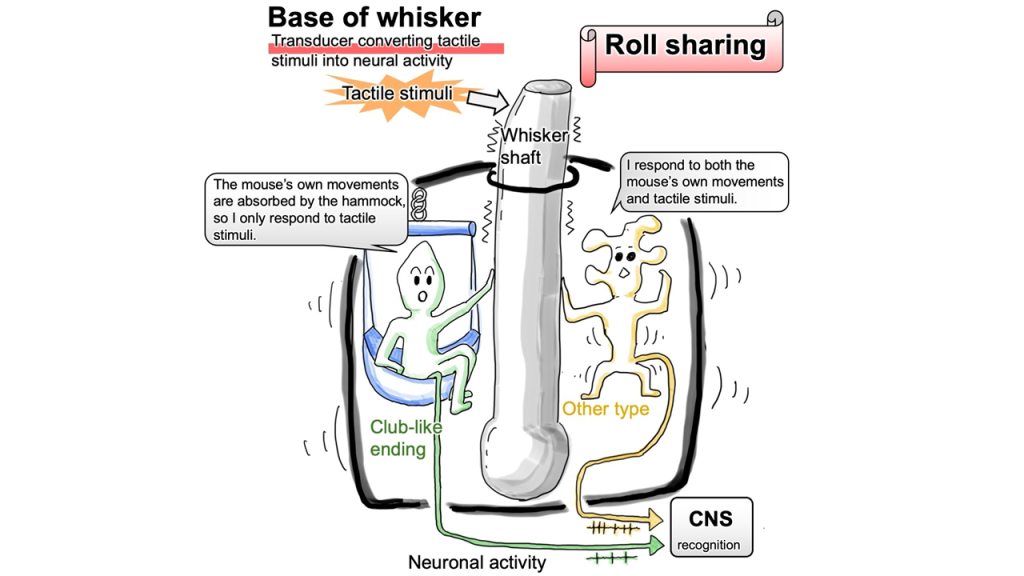
A research group at the University of Osaka has identified a distinct group of peripheral nerve receptors in mice, shedding new light on tactile perception. These receptors selectively respond to external tactile stimuli, impressively ignoring vibrations caused by the mouse’s own movement.
Unraveling the intricate mechanisms of tactile perception has lagged behind other sensory modalities, primarily due to the inherent limitations of experimental techniques in observing individual nerve activities. To overcome this challenge, they developed and successfully established a highly sophisticated methodology. This technique precisely analyzes both the activity characteristics and morphological data of individual neurons. Despite its high technical complexity, this method has been instrumental in elucidating neural circuits where individual nerve cells exhibit considerable variability in their properties, thereby advancing their understanding of peripheral nervous system mechanisms.
In this study, they focused on the mouse whisker tactile system. They employed advanced experimental techniques to meticulously record and analyze the electrical activity of individual peripheral nerves, alongside a detailed investigation of their morphological features. By comparing whisker movements during “empty strokes” (unobstructed movements) versus when they “made contact with an object,” they were able to identify a unique class of receptors (peripheral nerves) possessing distinct properties.
Furthermore, an in-depth electron microscopic examination of the structures surrounding these receptors revealed a sophisticated mechanism. This mechanism effectively serves to cancel out the extraneous vibrations generated by the animal’s own movements, allowing the system to accurately perceive only external tactile information.
This discovery sheds new light on how biological systems filter out self-generated noise to perceive the external world with remarkable precision, opening doors for future research in sensory biology and potential bio-inspired technological advancements.
The article, “Club-like receptors respond to light touch but not to whisking” was published in Nature Communications at DOI: https://doi.org/10.1038/s41467-025-67514-w