
Oral Compound Helps “Reset” the Body Clock Forward
Yoshifumi TAKAKHATA
Genome Editing Research and Development Unit
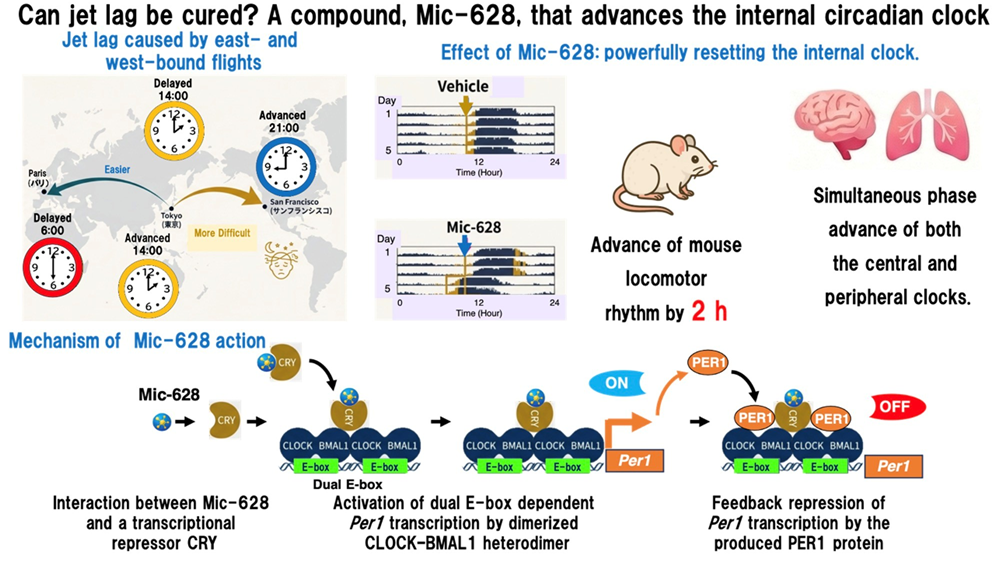
A research team including the University of Osaka, Kanazawa University, Toyohashi University of Technology, and Institute of Science Tokyo has made a significant discovery: an oral compound named Mic-628 capable of advancing the body’s internal clock. This breakthrough holds immense promise for faster recovery from jet lag and better adaptation for individuals engaged in night-shift work, offering a novel pharmacological approach to controlling circadian rhythms rather than relying on light exposure.
Mic-628 specifically works by activating the transcription of the essential clock gene, Period1 (Per1). Through a unique mechanism, it binds to the repressor protein CRY1, facilitating the activation of Per1 in both the brain’s central clock and peripheral tissues. Crucially, this phase-advancing effect was observed in mice regardless of the administration time, distinguishing it from existing methods like light therapy or melatonin, which are severely constrained by timing and often provide inconsistent results.
In a simulated jet lag mouse model, a single dose of Mic-628 reduced the re-entrainment time from seven days to just four. This stable and unidirectional advancement capability represents a groundbreaking strategy for resetting the circadian clock, especially for challenging adjustments like eastward travel or graveyard shifts.
Researchers envision Mic-628 as a prototype “smart drug” for managing various circadian misalignment disorders. Further animal and human studies are planned to assess its safety and efficacy.
The article, “A Period1 inducer specifically advances circadian clock in mice,” was published in the Proceedings of the National Academy of Sciences (PNAS) at DOI: 10.1073/pnas.2509943123.