
A Mechanism Behind Persistent Inflammation Revealed~Paving the Way for New Treatments for Inflammatory Diseases Such as Periodontitis~
Yuri NAKAMINAMI, Tomohiko MURAKAMI
The department of molecular and cellular biochemistry
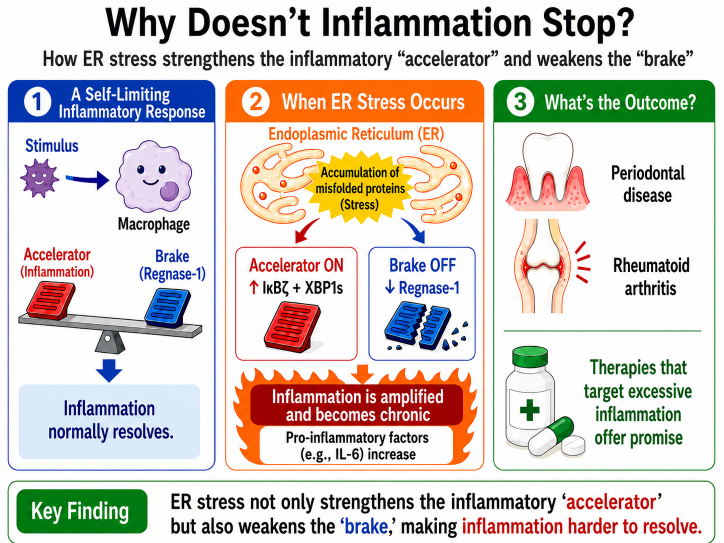
A research group from the University of Osaka has uncovered a mechanism by which endoplasmic reticulum (ER) stress, a form of cellular stress, amplifies and prolongs inflammation.
Inflammation is a vital biological response that protects the body from pathogens such as bacteria and viruses and helps repair damaged tissue. However, when inflammation becomes excessive or persistent, it can contribute to chronic inflammatory diseases such as periodontitis and rheumatoid arthritis. Although ER stress has been observed in tissues affected by these diseases, how it amplifies and sustains inflammation was not fully understood.
In this study, the research group conducted a comprehensive gene expression analysis of macrophages, key cells involved in inflammatory responses, and performed detailed investigations using multiple genetically modified mouse models. The researchers discovered that ER stress activates the inflammatory “accelerators” IκBζ and XBP1s while promoting the degradation of Regnase-1, a molecule that acts as an inflammatory “brake.” This disruption of the balance between the accelerators and the brake leads to the excessive production of inflammatory mediators such as IL-6, making inflammation more difficult to resolve.
These findings may contribute to the development of new therapeutic strategies that selectively suppress excessive and persistent inflammation without broadly inhibiting the protective functions of the inflammatory response.
The results of this study, “ER stress amplifies inflammation via a dual mechanism involving IκBζ–XBP1s synergism and Regnase-1 degradation” were published in the American scientific journal, The Journal of Immunology, on June 27 2026 at DOI: https://doi.org/10.1093/jimmun/vkag151